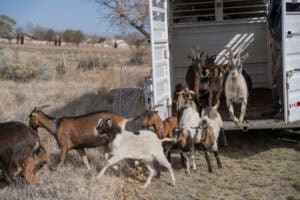
 This spring, Albuquerque Academy is tackling a familiar challenge with an unexpected — and delightful — solution. Instead of relying solely on machinery to clear tumbleweeds and overgrowth, the school is welcoming a herd of goats to campus.
The initiative, led by Director of Operations Adam Delgado, reflects both practical problem-solving and a commitment to sustainability. Beginning in mid-March, approximately 50 goats from Fire Goat Ranch began rotating through designated areas of the Academy’s open land, grazing on the dense vegetation that accumulates each year.
For Adam, stewardship of the Academy’s 312-acre campus is both a responsibility and an opportunity. While about 60 acres are developed, the remaining 250 acres of open space require constant attention — especially during New Mexico’s windy spring season, when tumbleweeds can spread quickly and extensively.
“Part of my role is caring for this land in a thoughtful way,” Delgado explained. “We’re always looking for solutions that are effective but also align with our values.”
The goats offer just that. Unlike tractors or brush hogs, which can disturb soil and require additional labor to clear debris, the goats provide a natural, low-impact alternative. As they graze, they not only remove unwanted vegetation but also fertilize the soil, supporting the long-term health of the landscape.
The herd itself is as distinctive as the project. A hardy mix of Alpine, La Mancha, Nubian, Boer, and a small group of Oberhasli goats, they have been bred for resilience in both hot and cold conditions. Many are part of a rescue lineage, given new purpose as part of Fire Goat Ranch’s vegetation management program. Their horns remain intact, helping them regulate body temperature and defend against predators. And they range in age from about two to three months up to seven or so years old.
Guiding them is a single goatherd, Jason White, who oversees their movements and ensures they remain within fenced grazing areas. The goats spend their days on campus but leave each evening, returning throughout the spring in phases to complete the project.
Their arrival has already generated excitement across the community. Students are encouraged to observe the goats — some of which are notably friendly — while following the goatherd’s guidance for safety. Plans were also made to bring the herd into more visible campus areas during GrandDays, offering families a chance to see the project up close.
While the goats are new to Albuquerque — and still adjusting to nearby traffic, their presence is expected to expand gradually across the property as they settle into their work. The project paused during spring break, resumed in early April, and will conclude with a final grazing period, probably in May.
Beyond its immediate impact, the initiative points to a broader vision. Adam hopes that by reducing invasive growth in a more natural way, the Academy can help restore its open spaces to a landscape that better reflects New Mexico’s native environment, with wildflowers and indigenous plants returning over time while also eliminating the obtrusive tumbleweeds.
