The yearbook editors had their reasons for crowning Dona Sosa the class “terror.” Her Nissan Sentra was fitted with McLean wheels, hydraulics, and a sound system that announced her arrival in the parking lot well before her arrival. Bravado came easily. “I was a little on the edge there,” she recalled.
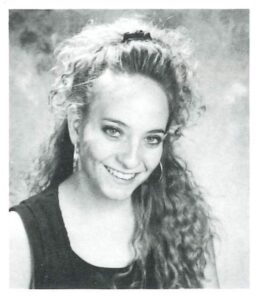
It is hard to discern that teenager in the Bel-Air Elementary School teacher she’s become, sitting in a hushed circle of three- and four-year-olds. The class is incubating chickens’ eggs, and the children quieted to listen for the tapping noise as they begin to crack out of their shells.
Dona has devoted the last 25 years to human beings at the threshold of their own world — three-, four-, and five-year-olds who have historically been viewed as too young for structured school.
It is not a career she anticipated. She grew up in Albuquerque’s Northeast Heights, and when her grandfather developed Alzheimer’s disease, her family relocated to the South Valley to take care of him in his home. She skated through school — “I was kind of just going through the motions” — but in 10th grade, her mom decided she should apply to the Academy.
“It was a whole culture shock because I had been in public school my whole life,” Dona recalled. “I did not fit the norm at all.”
Her new classmates had been together since sixth grade, and gaining entrance to their circles took time. Some of her closest relationships were with people other youth passed without a glance — the security guards, whom she’d bring breakfast burritos in the mornings.
Classes were hard, too. John O’Connor was a particularly unsparing English instructor, drilling students on “the four C’s,” foremost among them being concise. (Years later, when Dona aced the writing portion of her teacher-licensure exam, she thought of him.)
As she approached graduation, she had been imagining going out of state for college, maybe law school. But life had different plans. She was five months pregnant when she graduated. “So that was a learning lesson as well, to figure out how to navigate that.”
She took just a year off before enrolling at the University of New Mexico, where she chose the Early Childhood Multicultural Education Program because she wanted to understand how to give her own daughter the best possible start. And what began as a largely personal endeavor quickly became a calling. “Once I started teaching, I felt like that’s where I needed to be. This is what I was meant to do.”
For more than a decade afterward, Dona taught kindergarten at Armijo Elementary in the South Valley — “back to my roots,” as she put it. When the public school system eventually incorporated pre-K, she taught it there and then moved to Bel-Air Elementary, which is designated a Title 1 school because a large share of its students come from low-income families. Dona said she’d been offered jobs at private schools but turned them down. “These kids deserve a chance to have a good teacher and a good start.”
Over those years, she became convinced that no lesson reaches a child who has not first been seen. “Building those relationships is probably the piece that a lot of teachers don’t understand,” she said. “If you don’t have a relationship with them, they’re not going to be able to learn from you.”
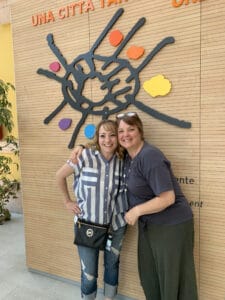
As part of her own continuing education, Dona has also embraced a pedagogy called the Reggio Emilia approach, which treats even very young children as competent, active participants in their own learning. That has reshaped how she runs her classroom.
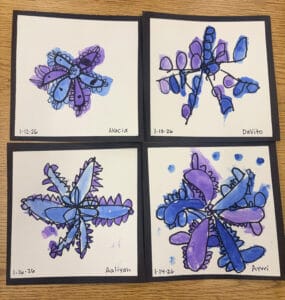
Instead of hanging standard didactic posters in the classroom, her students and their families make their own. Instead of passing out finger paints, she entrusts the three-year-olds with charcoal, watercolors, and clay and wire for sculpting — and students express themselves visually even before they can write. Last winter, her class spent months studying the New Mexico sky — clouds, contrails, the slow drift of snowflakes — and rendered it in watercolor. “It’s not just play,” she said. “They’re constructing meaning.”
She has since become a prominent advocate for the approach in the state and beyond, presenting and publishing about the practice. State officials now route observers to her classroom as a model of what good early-childhood education can look like.
And it’s starting to look like the vanguard of something truly revolutionary. New Mexico has lately garnered headlines for announcing what will eventually be universal free pre-K and subsidized child care — the kind of expansion Dona, in her quiet way, has been pushing for the better part of two decades.
“The whole world is seeing that New Mexico is offering this,” she said. “It’s my goal to make sure that we’re making progress with these kids.”
To highlight the impact of Academy alumni in the field of education, Alumni Council member Ted Alcorn ’01 is sharing the stories of graduates who have devoted their careers to teaching, learning, and inspiring others.
