By Ted Alcorn ’01
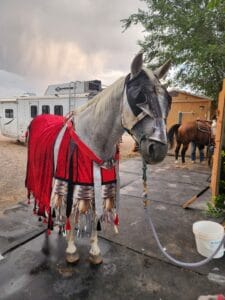
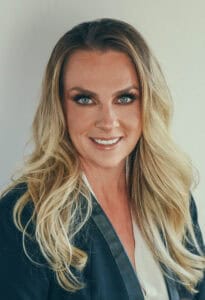 For her Senior Project, which some Academy students treat as a springboard to professional aspirations, Mariah Wilson ‘03 brought her horse to school and rode it bareback in the field beside the library. She said she was demonstrating Aristotle’s ideas about leadership and nonverbal communication — that character shows in bearing before it is heard in words, and that the way a statement is delivered persuades as much as what is said. More than 20 years later, at this fall’s homecoming football game, Mariah is bringing back her horse, this time a big white gelding costumed as a living Charger mascot. It is testament to the childhood passion that often drew her attention away from school turned out to be a life’s work, a successful business, and a way for thousands of other New Mexicans to find the freedom she found on a horse’s back.
No one else in her family rode, but on a visit to Rangely, Colorado, at the age of four, an aunt’s neighbor set her on a horse. “That was it,” Mariah said. “Kool-Aid was drunk.”
Her family was encouraging but wanted her to get a serious education and enrolled her in the Academy in the sixth grade, on a scholarship that carried her through all seven years. She rebelled against their expectations. “I just wasn’t interested in being told where I had to be and when,” she said.
At 12, she was mucking stalls at a local barn to get her own horse. At 14, she was hitching a horse trailer to a ‘72 Monte Carlo and driving to horse shows, sleeping in tack rooms at the fairgrounds afterward. When she wasn’t required to be in class, and sometimes when she was, she was at the barn.
Around the same time, her parents divorced, and the teenager spent months caring for her father through an addiction that eventually killed him. Back at school, she refused to be treated as a victim. “My reaction to all of that trauma was really to not want to be around authority figures, because I felt like all of my adults in my life let me down.”
But if she didn’t want sympathy, she needed structure, and that is what she found at the Academy. When Dean Lisa Myhre caught Mariah off campus, she neither scolded her nor treated her like a child. Mariah remembers her saying, “Look, if you want to get through this, here are very specific goals.”
Dr. Rolf Lokke, her economics teacher, was extremely patient. “They didn’t give me any slack because of the situation I was in, and I’m glad they didn’t,” Mariah recalled, “but they kept me on the rails.” She even lobbied Myhre to let her count her hours in the saddle toward physical education, arguing that equestrian was a recognized collegiate sport the Academy did not offer. She calls it her first successful crusade. The form the school created for this is still in use, and current Academy students who ride at her barn now bring it to her to sign.
The Academy and the horses were the twin stabilizing forces in her life. “The school made me do the work, by osmosis and by mere being there,” she said, “and the horses gave me that responsibility that I needed to take care of someone other than myself.”
The horses saw her through. After earning degrees in business administration and accounting, she married a rodeo roper, opened a barn on a piece of land in the South Valley — Platinum Performance Horses, and began showing horses professionally.
She’d hoped to board 20 horses to subsidize the cost of her own; today, the barn holds more than 80 and hHer staff give more than 100 lessons a week. The business wouldn’t be as successful without what she learned at the Academy, she says. She also manages the horse shows at the New Mexico State Fair, which have nearly doubled in size under her watch, and she is president of the Arabian Horse Association of New Mexico. In early September, as we spoke, she was driving a trailer of horses back from Reno, after a national-caliber show where her clients had competed, and she had previously been a judge.
The high-end show horses subsidize entry-level programming that most anyone can access, which is her way of pushing back against a culture that has gotten so exclusionary she herself would never have been able to be part of today. Each year she also writes a check back to the scholarship fund that paid her way through the Academy. And she works with the state Children, Youth, and Families Department to bring kids from abuse cases to the barn.
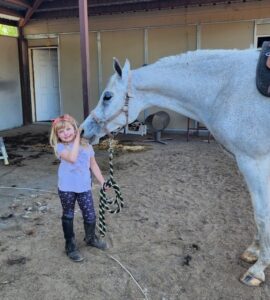
What they get, in her telling, is what she got. “The horses were the only place I felt accepted and heard and not judged,” she said. “They don’t care about your history or what happened to you this morning or three years ago.”
She sees the spark whenever a scared kid at one of her camps, set on a horse for the first time, feels it take a step. And it takes her back to her own first taste. “This horse is letting me borrow his legs, borrow his wings,” she said.
To highlight the impact of Academy alumni across diverse fields, Alumni Council member Ted Alcorn ’01 is sharing the stories of graduates whose leadership, service, creativity, and commitment are making a meaningful difference in their communities and professions.
