To highlight the impact of Academy alumni in the field of education, Alumni Council member Ted Alcorn ’01 is sharing the stories of graduates who have devoted their careers to teaching, learning, and inspiring others.
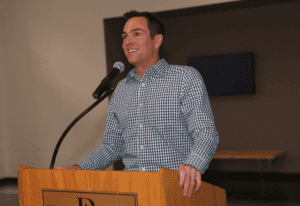 Frank Slevin was dying, but that wasn’t going to keep him from the classroom.
A legendary teacher who’d schooled generations of Albuquerque Academy students, he was diagnosed with cancer in early 1987, and when surgeons removed part of his jaw and throat, they’d also taken his ability to speak aloud. Students enrolled in his Advanced Placement English course that fall, including Michael Ulku-Steiner ’88, were told he might not return for it.
But on the first day of the term, there he was, his iconic white beard gone and face scarred from the procedures, a copy of Heart of Darkness in hand.
He would write a question on the board, Michael recalled, and so incisive was the thought he’d posed that the students would wheel off for minutes of discussion. Listening mutely, Mr. Slevin would follow the conversation with his eyes before returning to the board to tap it until the room fell silent. Then he’d write out another question.
Michael still remembers this vividly nearly 40 years later. “That was certainly sacred,” he said.
They had only a few weeks together. In September, Frank Slevin stopped coming in, and he died shortly thereafter. But now midway through his own career as an educator, Michael can appreciate just how formative the experience was.
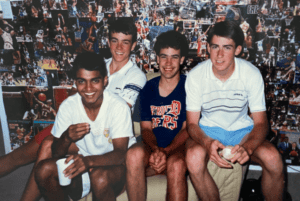 He was part of the last all-boys class of sixth graders to enroll at the Academy. His classmates — who would go on to become actors, athletes, artists, and musicians — amazed him. “Everybody had some superpower or two,” he recalled.
Middle school was rowdier without girls, he thought, but made for intimacy among the boys that forged close ties. “It was a loony place — so much nonsense and hilarity and tomfoolery.” To this day, he counts a trio of classmates among his closest friends. It was still fun once girls joined in the ninth grade, he said, even if “it got complicated, and more civilized.”
The culture of curiosity and healthy competition pushed everyone academically, too. “It was a really rich soil for learning and never felt like it because it was so much fun to be there.”
Michael did well in his classes and excelled at sports, including on a “radically undersized” basketball squad that nevertheless made it to the state semifinals at UNM’s Pit arena. But looking back, he saw himself “bouncing through like a pinball, doing what my parents and my peers and my teachers wanted me to do,” rather than captaining his own ship.
It was good enough to win him a Morehead Scholarship for four years at the University of North Carolina, where he studied English and Spanish and art history. Upon graduating four years later, looking for professional experience before law school and trying to stay near a girlfriend, he interviewed for a job at an independent school just down the road called Durham Academy.
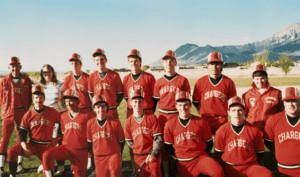 The role didn’t require a teaching certification and was an uncanny fit: the school needed an English and Spanish instructor, ideally one who could also coach baseball and basketball. Michael was hired — and terrified.
At age 22 he was back in the classroom, closer in age to his pupils than to their parents. At an open house his first month, dressed to impress in his only blue blazer, he was welcoming families when a mother mistook him for a student guide and asked for directions to Mr. Steiner’s classroom.
“I was completely faking it and making it up as I went,” he said of those first years. But he had the right models. “I was acting like Bruce Musgrave and John Riley and Mike Brown and Martha Mentch, basically just channeling the good teachers and mentors and coaches I’d had.”
A passion for teaching quickly began to take hold in him — the challenge of planning lessons, watching the clock, tuning in to every student and how they were interacting with one another and with the material, “like a puzzle that never got dull.”
 Three decades later, he’s still at Durham Academy, having learned to teach, then to administer, twice stepping away to educate overseas, always coming back. He watched his own children attend and graduate.
Now 12 years into his term as head of school, a big part of his work is trying to keep kids thriving while also better connecting the school with the community — “more Durham, less Academy,” as he puts it. When he arrived in 1992, seven percent of students identified as people of color; now 50 percent do.
He teaches, too, and still sometimes feels he’s ham-handedly stumbling through his lessons, making it up as he goes. But the question burning in him remains the same: how do we turn a child into a person with capacity and courage and compassion?
His students poke fun at him for insisting they make the most of every single minute together, but it’s his way of affirming to them the most important lesson of all: the human potential all around us. “This matters,” he said. “Let’s pay attention to each other.”
