 In honor of the school’s 70th anniversary, we asked alumni to share their Academy memorabilia and memories. This submission is from Nate Goetz ’93, today a writer residing in Chapel Hill, North Carolina.
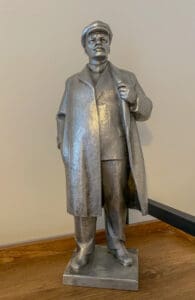 Standing upon my office bookshelf is a foot-tall statue crafted of cold Soviet steel that once kept watch over a geopolitical landscape that no longer exists. Vlad, as I call him, is my Albuquerque Academy memento. Purchased on a St. Petersburg, Russia street corner, Vlad lay haphazardly next to a stack of t-shirts printed in English with the phrase, “The Party’s Over.” It was early Spring 1993. The Soviet Union was no more. Yet, its remnants lingered as a group of Academy students participated in an exchange program at St. Petersburg School #631. We all brought back mementos. I brought back Vlad. Not because I admire him, but as a reminder of what ideology can do when valued over humanity.
There was not one of us on the trip who didn’t watch the November 1989 fall of the Berlin Wall. I clearly recall sitting in class, the day’s lessons put on hold so we could witness the world changing before our eyes, and in true Academy fashion, discuss the significance. To borrow an expression from Billy Joel’s poignant song Leningrad, we were “Cold War kids” and grew up with terms like Iron Curtain in our vocabulary. Now, suddenly, we became aware of a word introduced by Mikhail Gorbachev not long before, which set this historic event in motion: Glasnost (openness).
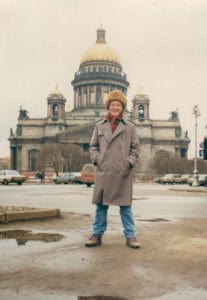 While Glasnost did its part to usher in the Soviet Union’s dissolution, it allowed our group to set foot in a place that until that point was forbidden yet remained quite mysterious. Indeed, the evening we touched down in Moscow — the Cold War’s epicenter — it was clear Russia was grappling with change after decades of authoritarian rule. My senior project, advised by Giles Pennington and the late John O’Connor, focused upon collecting personal accounts about what life was like in the USSR until its collapse. In the project journal, I recorded my first impression:
“Arriving at the Moscow station for an overnight train to St. Petersburg, it felt much like I envision life in the USSR must have been. A larger-than-life statue of Vladimir Lenin looked down harshly as if to warn anyone thinking of escaping the bond of ideological conformity. No one smiled, and if they looked at me, it was with suspicious eyes. Foreboding chimes rang out, followed by monotone announcements echoing from loudspeakers in a language I didn’t understand.”
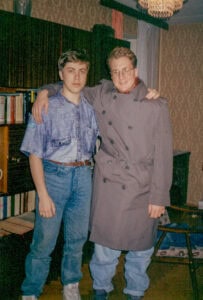 After a sleepless train ride, it took a while to get acclimated. I’d never left the United States and was anxious about being in a place well beyond my comfort zone. Thankfully, I was greeted by a familiar face. I’d already met my host brother, Yuri, who’d stayed with me while visiting the Academy with his school’s delegation a few months prior. We’d initially bonded over a love of hamburgers and Queen, one evening cruising down Montgomery Boulevard searching for Albuquerque’s best burger with Freddy Mercury’s epic voice providing the soundtrack. The next day, I told Mr. O’Connor about it, and, in his well-known gruff tone, he asked why we had done such a thing.
“It was an experiment in capitalistic excess, sir!” I joked irreverently.
Unlike me, he did not find the quip amusing, and for the years John and I kept in touch before his passing, he’d still bring it up on occasion!
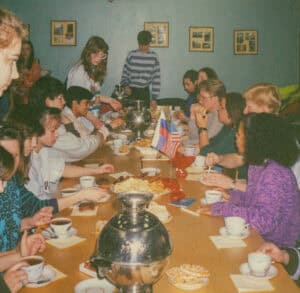 While the daily experience of attending a Russian high school was an exciting prospect, we were not integrated into the student population; rather, given lessons while confined to a single room during the three-week visit. Also, noticeably absent from the curricula was politics. Whether intended or not, I had to seek out other opportunities to learn about what the Russian people endured. That came from conversations with my host family, in particular Yuri’s grandmother, Maria.
Maria lived alone, strong and resilient, having felt the terror of Stalin’s purges, mass starvation during the Siege of Leningrad, and the hardship and uncertainty of communism. Yet, with kind eyes, she doted upon her grandson and me, making us piping-hot pancakes and tea. Yuri would then patiently translate as she told stories of her lived experience. As she spoke, I realized that for a people whom our government told us were the enemy, humanity had been erased from that message entirely, just as it had been for Russians living under Soviet rule. It was a profound lesson, indeed.
One afternoon on the way home from Maria’s, I saw something familiar being sold by a street vendor. It was a copy of the Vladimir Lenin statue I’d seen in the Moscow train station. Picking it up, the diminutive Vlad glared at me just as his larger counterpart had done upon my arrival weeks earlier.
“Why do you want that ridiculous thing?” Yuri asked incredulously.
For a moment, I almost put Vlad back but then thought of Maria and what she experienced; never losing her humanity, even in the bleakest of times. I realized the statue was the antithesis of that, a stark reminder of ideology’s danger and the resulting loss of virtue.
“I don’t want to forget,” I answered.
And three decades on, I still have not.
