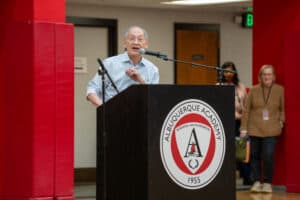
 When students asked Arthur Sze how he first knew that writing was what he wanted to do, he traced the answer back to his freshman year at MIT. He arrived intending to study math and science, he told them but began taking poetry workshops almost by accident — a discovery that ultimately reshaped his academic path and his life’s work.
Now the 25th United States Poet Laureate, Arthur, visited campus as part of the Ogawa Speaker Series, speaking with students about how attentiveness to language, the natural world, and lived experience gradually drew him toward poetry. Living in Santa Fe, he has built a career that bridges disciplines, weaving scientific curiosity, ecological awareness, and translation into his writing. During his presentation, he reflected on how these influences shape his work and read poems inspired by moments of close attention — an owl lifting dust from its wings, light fading during a drive through New Mexico, ice melting into water — encouraging students to notice the ordinary details that can become sources of meaning.
Arthur described writing as a process of discovery rather than certainty, explaining that some of his strongest poems emerge when he does not know where they will end. Even in moments of uncertainty, he suggested, creativity offers clarity: a brief chance “to shine.”
 Student questions continued to shape the visit throughout the all-school assembly. They asked about balancing interests in science and the humanities, how poets find inspiration, and what it means to sustain a creative life over time. He emphasized curiosity and openness, encouraging students to follow interests even when the path ahead feels unclear.
A smaller group of students spanning all grades, along with Head of School Julianne Puente, Director of Diversity, Culture, and Belonging Peter Gloyd, and representatives from the Asian American Parent Council, continued the conversation with him over lunch, where questions turned more personal and exploratory. Students asked how writers draw from their cultural backgrounds, how long poems take to develop, and how poetry connects with other art forms. Arthur described translation as “the deepest form of reading” and encouraged students to read widely, collaborate with others, and engage deeply with language they love.
His career also reflects a long-standing commitment to education and cultural exchange, including his work as a translator of Chinese poetry and his involvement with Native American education, arts, and creativity through the Institute of American Indian Arts. His visit invited students to see poetry not as a separate pursuit, but as something rooted in curiosity, attention, and lived experience — shaped as much by questions as by answers.
Launched in 2023, the Ogawa Speaker Series is a platform for intellectual exploration designed to challenge conventional wisdom, question prevailing assumptions, and embrace growth in diversity, community, and belonging.
