Clair Toledo ’00 has spent two decades as an educator in some of New Mexico’s most challenging schools
By Ted Alcorn ’01
One of the most important lessons the Academy imparted on Clair Toledo ’00 wasn’t something she learned in a classroom or on campus at all.
After an infamous spat between the school’s football team and its rival at St. Pius X High School, the respective student councils decided to build a house together, under the guidance of Habitat for Humanity. Clair, then a sophomore, volunteered to help.
Each Saturday, about a dozen kids from each school gathered at the construction site and put in eight hours of labor, working alongside the family who would get to inhabit it.
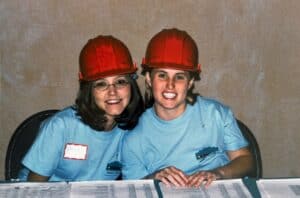
It was a revelatory experience for Clair, and not only because she had never hammered in a nail. “To realize that families don’t have basic housing, that families might be living in a garage with no running water just down the road from you — it just opened my eyes,” she recalled.
She took such satisfaction in the process that, when the house was completed, she decided to help Habitat for Humanity with another, and then another. She even volunteered for the organization as her senior project.
And though she didn’t yet see where she was heading, it set her on a path seeking “a life where service meant more than achievement,” as she put it, adding, “Don’t get me wrong, I’ve had a lot of great achievements, but the service came first.”
Figuring out how to serve was another question. Clair was a math whiz who held Gene Gardenhire and Janet Wilson among her favorite teachers, and after she graduated early from college, she considered seeking a graduate degree in pure mathematics or operations research.
But back in Albuquerque for a spell, she started teaching remedial math at a community college, instead, and then as a substitute at the Academy, and she saw firsthand what education meant for students. She never looked back.
She was particularly drawn to institutions serving kids at greatest risk, like the School for Integrated Academics and Technology (SIATech), a charter school where she found herself teaching math and special education. The students, who ranged in age from 16 to 24, had dropped out of previous programs but were trying to get back on track. “Students who had been pushed out of the education system, or had been pushed off to the side,” Clair recalled. “The students that everybody else forgot.”
The stakes, she quickly realized, were life-or-death: she lost students to drunk-driving accidents, drug overdoses, and suicide. But that made it all the more rewarding when people succeeded.
In 2022, she got an opportunity to think even bigger. Los Lunas’s Century High School had 22 high-needs students on campus, a graduation rate hovering around 20%, and an opening for a new principal.
Working with a devoted team of faculty, Clair set about making changes. Part of her role was to find resources to support her kids, so she networked with outside therapists and nurses, the juvenile probation department, housing and food assistance programs — anyone in a position to help. “When students are in that survival mode, they can’t learn, and then, if they can’t learn, they can’t get through high school,” she said.
Then she set about meeting students where they were at. The school developed a hybrid model that better suited students juggling work or family obligations. With a little grant money, the staff developed after-school classes to engage students’ passions, from weightlifting to sewing to cooking. In the Dungeons and Dragons club, the teacher intersperses Greek mythology.
Clair says she is constantly thinking about how to make the most of each moment, since her students are older and more prone to dropping out or moving on. “What two things can we do at the same time to be more efficient, so that we can take kids that are behind on graduating, and catch them up?”
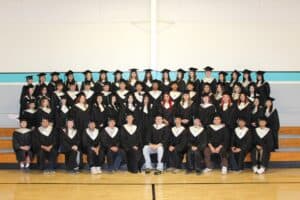
But it can also take time. Some students need months to work through an underlying issue before they can turn to their education, Clair said, and that’s OK. “Skills to be successful in life are just as important as skills to be successful academically,” she said. “Sometimes you’ve got to deal with other things first.”
Not everything succeeds, but the combination is working. In 2025, the school graduated 101 kids, and Clair said the graduation rate was nearing 55%. Clair’s goal is to match the rate in traditional public schools. “We’re right on their heels,” she said.
To highlight the impact of Academy alumni in the field of education, Alumni Council member Ted Alcorn ’01 is sharing the stories of graduates who have devoted their careers to teaching, learning, and inspiring others.
