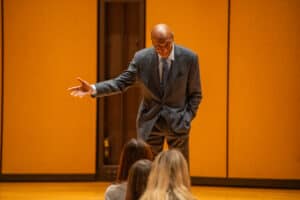
 Students across all grades gathered to welcome former Merck Chairman and CEO Kenneth C. Frazier as the featured guest speaker for this year’s Ramo Speaker Series. Established by Roberta Cooper Ramo — a prominent attorney, former president of both the American Bar Association and the American Law Institute, and mother of Academy alumni Joshua ’87 and Jenny ’88, the series brings distinguished national figures, legal scholars, and public leaders to speak to students at the Academy and a partner public school. Designed to deepen student understanding of Constitutional history, the Constitution, and the responsibilities of citizenship, the series has previously hosted notable figures such as California Supreme Court Associate Justice Goodwin Liu and U.S. District Judge Yvonne Gonzalez Rogers.
Opening his remarks with warmth and humor, Mr. Ken Frazier moved past “what’s on your business card” to share his personal story of growing up in inner-city Philadelphia. After his mother passed away unexpectedly when he was 12, he and his siblings were raised by his father, Otis Frazier — a man born in 1900 in South Carolina with only a third-grade education who read two newspapers every day and refused to accept societal limitations. Recalling a pivotal moment at age 16 when he worried about fitting in without the latest sneakers, Ken shared his father’s enduring advice: “Kenny, what other people think of you is none of your damn business. And the sooner you realize that, the better off you’ll be.” Reflecting on the academic and social media pressures facing today’s students, Ken emphasized that defining oneself independently is the most important task of young adulthood.
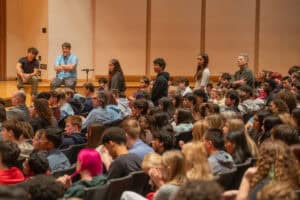
Service and truth, Ken told the students, are critical to democracy, so he aimed to help others through his legal career. Before his 31-year tenure at Merck, where he served as CEO for a decade, and his career at Drinker Biddle & Reath (now Faegre Drinker), he took on a pro bono death penalty case in Alabama for James Willie “Bo” Cochran, who had spent 19 years on death row and was 30 days from execution. After prison guards told Ken that everyone knew Cochran was innocent, Ken and his colleagues tracked down a key witness in Texas and uncovered evidence of a mistaken-identity police shooting, leading a jury to acquit Cochran in less than an hour.
Transitioning to truth in a digital age, Ken pointed to the resurgence of preventable diseases like measles as a consequence of online misinformation. He also urged students to pause when something they see online triggers outrage, verify claims across multiple sources, and hold their own political side to the same standard of truth as their opponents. “Service without truth becomes manipulation,” Ken said. “I also say that truth without service is cheap…. Many people treat our government like it’s a restaurant. When you go to a restaurant and don’t like the food or the service, you can complain and never come back. That’s not how government works. We talk about ‘We the People.’ It’s not ‘We the Customers.’ It’s not ‘We the Audience.’
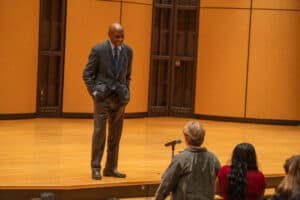 During the Q&A session, students pressed Ken on how social media is reshaping the political climate and desensitizing young people to political violence. Ken noted that today’s fragmented media landscape “amplifies our disagreements” compared to his youth, when people debated policy while sharing a common set of facts. He warned against letting online culture erode basic humanity: “It coarsens our empathy for one another…. We should not be glorifying or celebrating” violence against others, regardless of political differences.
Following lunch, he visited Drew Westfahl’s AP U.S. History class, where he drew a connection between John C. Calhoun’s states’ rights argument and examples of states’ rights arguments used today.
